By Ahmaad Rafat (Kayhan Life)
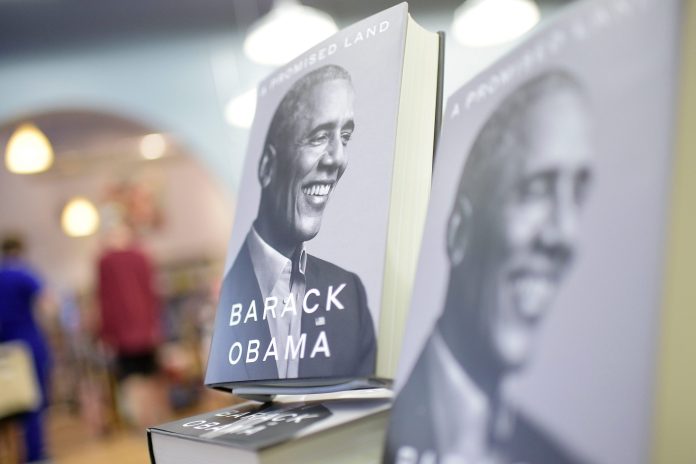
Former U.S. President Barack Obama’s memoir A Promised Land has been a mega-bestseller since its release on Nov. 17. As of late December, more than 3 million copies of the 751-page tome had sold worldwide.
The first of two volumes, the book focuses on Obama’s personal life and political career — including his efforts to reach a nuclear agreement with Iran — and ends with the assassination of Al-Qaeda leader Osama bin Laden in 2011. The second volume will cover the rest of the Obama presidency, and delve deeper into U.S.-Iran relations.
In the memoir, Obama tries to justify his Middle East policy and, in particular, his decision — from the moment he enters the White House — to reach an agreement with Iran. It is a line of action he sets out clearly in his now famous speech at the University of Cairo in June 2009 — a few days before Iran’s widely contested presidential elections.
Obama’s determination from the start to talk to Iran explains why Iran’s Green Movement could never count on the support of his administration.
Demonstrators in Iran were so uncertain of that support that they came up with a slogan to express it, which they shouted out in the streets: Obama: ya ba oona, ya ba ma (‘Obama: either with them, or with us’).
Obama’s choice not to side with the Green Movement paved the way for negotiations — first in secret, and later in the light of day — with three European states, China and Russia, and the signing of the Iran nuclear deal, the Joint Comprehensive Plan of Action (JCPOA).
The deal was aimed at reducing the power and influence of the ayatollahs in Tehran. Instead, they strengthened their political and military presence in the region, thanks also to the flow of money into the coffers of the Islamic Republic.
Below are relevant excerpts from the Obama memoir.
On the situation in Iran at the start of his presidency:
“By the time I took office, conservative hard-liners were firmly back in charge in Tehran, led by a new president, Mahmoud Ahmadinejad, whose manic anti- Western outbursts, Holocaust denial, and persecution of gays and others he considered a threat made him a perfect distillation of the regime’s most hateful aspects,” Obama writes. “Iranian weapons were still being sent to militants’ intent on killing American soldiers in Iraq and Afghanistan. The U.S. invasion of Iraq had greatly strengthened Iran’s strategic position in the region by replacing its sworn enemy, Saddam Hussein, with a Shiite-led government subject to Iranian influence.”
“Hezbollah, Iran’s proxy, had emerged as the most powerful faction in Lebanon, with Iranian-supplied missiles that could now reach Tel Aviv. The Saudis and Israelis spoke in alarming tones of an expanding ‘Shiite Crescent’ of Iranian influence and made no secret of their interest in the possibility of a U.S.-initiated regime change,” Obama says. “Under any circumstances, then, Iran would have been a grade-A headache for my administration. But it was the country’s accelerating nuclear program that threatened to turn a bad situation into a full-blown crisis.”
On his support for the Green Movement and the 2009 protests:
Obama highlights the plight of the leaders of the Green Movement, including former Prime Minister Mir-Hossein Mousavi, who has been under house arrest since then. Obama also laments the tragic death of Neda Agha-Soltan, a 26-year-old Iranian girl who was allegedly shot and killed by members of Basij forces during the protests on June 20, 2009.
“The ensuing crackdown was merciless and swift. Mousavi and other opposition leaders were placed under house arrest,” Obama writes. “Peaceful marchers were beaten, and a significant number were killed. One night, from the comfort of my residence, I scanned the reports of the protests online and saw the video of a young woman shot in the streets, a web of blood spreading across her face as she began to die, her eyes gazing upward in reproach.”
“It was a haunting reminder of the price so many people around the world paid for wanting some say in how they were governed, and my first impulse was to express strong support for the demonstrators,” Obama notes. “But when I gathered my national security team, our Iran experts advised against such a move. According to them, any statement from me would likely backfire. Already, regime hard-liners were pushing the fiction that foreign agents were behind the demonstrations, and activists inside Iran feared that any supportive statements from the U.S. government would be seized upon to discredit their movement.”
“I felt obliged to heed these warnings, and signed off on a series of bland, bureaucratic statements — ‘We continue to monitor the entire situation closely’; The universal rights to assembly and free speech must be respected” — urging a peaceful resolution that reflected the will of the Iranian people,’” Obama explains. “As the violence escalated, so did my condemnation. Still, such a passive approach didn’t sit well with me — and not just because I had to listen to Republicans howl that I was coddling a murderous regime.”
“I was learning yet another difficult lesson about the presidency: that my heart was now chained to strategic considerations and tactical analysis, my convictions subject to counterintuitive arguments; that in the most powerful office on earth, I had less freedom to say what I meant and act on what I felt than I’d had as a senator — or as an ordinary citizen disgusted by the sight of a young woman gunned down by her own government,” Obama adds.
On his secret letters to Iran’s Supreme Leader, Ayatollah Ali Khamenei.
“I had spent much of the transition discussing how to prevent Iran from getting a nuclear weapon — ideally through diplomacy rather than by starting another war. We settled on a two-step strategy. Because there had been almost no high-level contact between the United States and Iran since 1980, step one involved direct outreach,” Obama writes. “As I’d said in my inaugural address, we were ready to extend a hand to those willing to unclench their fists.”
“Within weeks of taking office, I’d sent a secret letter to Ayatollah Khamenei through a channel we had with Iranian diplomats at the United Nations, suggesting that we open a dialogue between our two countries on a range of issues, including Iran’s nuclear program,” Obama explains. “Khamenei’s answer was blunt: Iran had no interest in direct talks. He did, however, take the opportunity to suggest ways the United States could stop being an imperialist bully. ‘Guess he’s not unclenching his fist anytime soon,’ Rahm said after reading a copy of Khamenei’s letter, which had been translated from Farsi. “Only enough to give me the middle finger,’ I said.
On his willingness to meet Iranian President Ahmadinejad:
Recalling a debate during the 2007 presidential election, Obama writes: “I was starting to look different from my Democratic rivals in more ways than the obvious one. During a debate in late July, I was shown images of [Cuban President] Fidel Castro, Iranian president Mahmoud Ahmadinejad, North Korean leader Kim Jong Il, and a couple of other despots and asked if I’d be prepared to meet with any of them during my first year in office. Without hesitation, I said yes — I’d meet with any world leader if I thought it could advance U.S. interests.”
On the nuclear negotiations with Iran:
“Having been rebuffed in our attempts to open a dialogue with Iran, and with the country spiraling into chaos and further repression, we shifted to step two of our non-proliferation strategy: mobilizing the international community to apply tough, multilateral economic sanctions that might force Iran to the negotiating table,” Obama writes. “The U.N. Security Council had already passed multiple resolutions calling on Iran to halt its enrichment activities.”
Explaining the role of P5+1, the principal architects of the JCPOA, Obama writes: “It had also authorized limited sanctions against Iran and formed a group called the P5+1 — representing the five permanent Security Council members (the United States, the United Kingdom, France, Russia, and China) plus Germany — to meet with Iranian officials in the hope of pushing the regime back into Nuclear Non-Proliferation Treaty compliance.”
“The problem was that the existing sanctions were too weak to have much of an impact. Even U.S. allies like Germany continued to do a healthy amount of business with Iran, and just about everyone bought its oil,” Obama notes. “The Bush administration had unilaterally imposed additional U.S. sanctions, but those were largely symbolic since U.S. companies had been blocked from doing business with Iran since 1995.”
“With oil prices high and its economy growing, Iran had been more than happy to string along the P5+1 with regular negotiating sessions that produced nothing other than a commitment to more talking,” Obama adds. “To get Iran’s attention, we’d have to persuade other countries to tighten the vise. And that meant getting buy-in from a pair of powerful, historic adversaries that didn’t like sanctions as a matter of principle, had friendly diplomatic and commercial relations with Iran — and mistrusted U.S. intentions almost as much as Tehran did.”
On U.S. wanting to counter Iran’s influence in Iraq:
In chapter eight of the book, Obama discusses Iran’s ties with Iraq and its role in the Middle East. He recalls a visit to the Bagram Airfield, a U.S. military base, 25 miles north of the Afghan capital Kabul, after which he traveled to Baghdad to hold talks with Iraqi Prime Minister Nouri al-Maliki (in office 2006-14).
“Indeed, al-Maliki’s ties to Iran, where he had lived in exile for many years, as well as his uneasy alliances with certain Shiite militias, made him anathema to Saudi Arabia and other U.S. allies in the Persian Gulf region, underscoring just how much the U.S. invasion had strengthened Iran’s strategic position there,” Obama writes, highlighting Mr. al-Maliki’s ties to Tehran. “Whether anyone in the [President George W.] Bush White House [in office 2001-09] had discussed such a predictable consequence before ordering U.S. troops into Iraq was uncertain.”
“But the administration sure wasn’t happy about it now. My conversations with several high-ranking generals and diplomats made clear that the White House’s interest in maintaining a sizable troop presence in Iraq was about more than a simple desire to ensure stability and reduce violence,” the former president explains. “It was also about preventing Iran from taking further advantage of the mess we’d made.”
The opinion expressed do not necessarily reflect those of ITC


