
| By Fred Kempe, Atlantic Council president and CEO
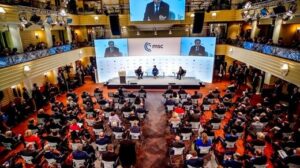
MUNICH—The stench of appeasement hung over the Munich Security Conference this past weekend, leaving more than a few European leaders making comparisons to September 1938. That was when a very different Munich meeting placated a murderous dictator—with disastrous consequences. It was then that British Prime Minister Neville Chamberlain, meeting with Nazi leader Adolf Hitler and their French Republican and Italian fascist counterparts, signed off on the Third Reich’s annexation of the Western part of Czechoslovakia (which the Germans called Sudetenland), naively hoping that would allow them to avoid a larger European war. With the two-year mark of Russian dictator Vladimir Putin’s full-scale invasion of Ukraine coming up this week—and with his ongoing war and occupation of sovereign Ukrainian territory—it’s worth reflecting on the dynamics behind the 1938 Munich Agreement and Chamberlain’s subsequent “Peace for Our Time” speech, as they may hold lessons for US lawmakers in the House of Representatives who continue to balk at approving urgently needed support for Ukraine after four months of dithering in Congress. Hitler had threatened to unleash a European war unless the leaders of Britain, France, and Italy agreed to German annexation of the Sudetenland, a border region with an ethnic German majority. “My good friends,” Chamberlain said in a statement in front of 10 Downing Street, “for the second time in our history, a British prime minister has returned from Germany bringing peace with honor. I believe it is a peace for our time . . . Go home and get a nice quiet sleep.”
There are plenty of differences between then and now, but one shouldn’t overlook the striking similarities. First, Hitler had annexed German-speaking Austria in March 1938, and he was determined to swallow up the German-speaking Sudeten region of Czechoslovakia next. Today, Putin has already occupied and annexed portions of Ukraine with sizable numbers of Russian speakers—areas that he considers to be his property: Crimea, Luhansk, Zaporizhzhia, Kherson, and Donetsk. Hitler wrote at length about his warped historic, genetic, and anti-Semitic notions in Mein Kampf, providing a copy of his national best-seller to every young marrying couple in Third Reich Germany. By comparison, Putin most recently shared his own twisted justifications for denying Ukrainian statehood, dating back to the ninth century, with American media personality Tucker Carlson—not such a bizarre vehicle if one considers Carlson’s influence on a Republican minority in the House that is currently standing in the way of approving additional aid for Ukraine. And just as in 1938, when the focus of debate was on the future of Czechoslovakia and when commentaries praised the country’s bravery and resilience, so too now is the focus on Ukraine. Back then, the more appropriate focus should have been on the dictator responsible for the threat and on how to stop him. Today, the more appropriate focus is no different. One more similarity between 1938 and today is the gradual alignment of authoritarian powers. Shortly after Chamberlain’s infamous Munich Agreement, a fascist-nationalist German-Italian-Japanese axis of nations emerged. Today, European and US leaders alike have observed an increasingly close alignment among Russian, Chinese, Iranian, and North Korean authoritarian leaders. A morose Munich The Munich Security Conference this week, which marked the convening’s sixtieth anniversary, is as good a measure of the transatlantic zeitgeist as any. Yet four news events that unfolded outside of Munich soured the mood: Former US President Donald Trump’s campaign trail statement that he would let Russians “do whatever the hell they want” to NATO allies not paying enough for defense; the death in prison of Russian opposition leader Alexei Navalny; the biggest Russian battlefield victory in months in the Ukrainian city of Avdiivka; and leaked reports of Moscow’s plans to develop a nuclear space weapon, which the Atlantic Council’s John Cookson suggested could be a “Sputnuke” moment. On Trump’s statement, a range of Republican supporters of Trump in Munich were at pains to explain why their presidential candidate should be taken seriously but not literally, as US military support for Ukraine, Poland, and NATO increased during his administration. Their argument that Trump simply wants Europeans to carry more of their own defense still left allies worried that they are in for a long period of US unpredictability. Regarding Navalny, his wife Yulia (who was in Munich to speak on his behalf) provided a courageous first response to reports of his death, accusing Putin of killing him and vowing that the Russian dictator would pay for it. Some long-time Munich conference participants, who heard Putin’s initial declaration of war on the West there in 2007, speculated that he might well have timed Navalny’s death with the Munich gathering to send an unmistakable message of the West’s powerlessness to stop such outrages. “It sounds like Putin might have done it for our benefit,” said Polish Foreign Minister Radek Sikorski. “I’m not prone to conspiracy theory, but I understand conspiracy practice.” It is impossible not to link Russian advances in Ukraine with the long delay in US congressional support for new weapons deliveries, as the outgunned and outmanned Ukrainians struggle to hold the line against Russian forces commanded by Putin, who is willing to suffer outsized casualties. Ukrainian President Volodymyr Zelenskyy said that in the battle for Avdiivka, Russia’s losses were seven times those of Ukraine. If “Ukraine is left alone, Russia will destroy us,” Zelenskyy told the Munich conference. “If we don’t act now, Putin will succeed in turning the next few years into a catastrophe —not only for Ukraine but for others as well.” On “Sputnuke,” the consensus in Munich was a resigned European shrug as Russia marches on, develops asymmetric advanced weaponry that could take down European communications in space, and shifts to a war footing that Europe’s democracies will never match. Writing for the Washington Post, David Ignatius pointed out Russia’s motivation for developing such weaponry: “Ironically, it’s the Ukraine conflict—and the role of space systems in helping Kyiv survive the initial Russian onslaught in 2022—that likely triggered Russia to rush development of its new space tactics.” Four causes for concern The concerns and fears at Munich this year, which far overwhelmed rare voices of optimism, broke down into four mutually reinforcing categories. The first fear was about Russia’s resilience and Putin’s increasing confidence, which contributed to a growing conviction that Russia will remain a problem for the West for some years to come. The second concern stemmed from the possibility that Ukraine might lose the war, with a growing danger that it could be overwhelmed by Russian military mass, and from an assessment of the repercussions of that scenario most immediately for other former Soviet bloc states, from Poland to the Baltics, but also globally, from the United States to the Middle East and Asia. The third concern, one that pervaded almost every conversation at the conference this weekend, was about the potential for a reduced US commitment not only to Ukraine but also to the nearly eighty-year-old transatlantic bond, particularly should Trump be elected in November. The fourth fear, closely connected to the third, was that Europe still lacks the military industrial capacity and the political will to defend itself, let alone defend Ukraine. Though Europe is ramping up its defense industrial production and increasing its spending, it would take years for European countries to replace US capacity, if they ever could. The past three Munich Security Conferences have all focused on Ukraine, and each year the conventional wisdom has missed the mark. One can only hope that is true again. In 2022, there were growing concerns that Putin would invade Ukraine, which did happen, but there was also a consensus that Ukraine would be overrun within days by such a military offensive. In 2023, the mood was more positive, with many voices believing that Ukraine’s remarkable performance in the previous year could lead to a stunning counteroffensive that would help Kyiv regain territory occupied by Russia. The collective view is that 2024 will be a moment of truth in Ukraine. Without US congressional approval for additional support soon, the thinking goes, the odds are that Russia will continue to make gains and that some could be dramatic by the time of the seventy-fifth NATO Summit in July in Washington, DC—just ahead of US elections. It is worth remembering the calls of “shame” from the House of Commons galleries, as Chamberlain defended his Munich arrangements in 1938. “I have nothing to be ashamed of,” he answered back. “Let those who have hang their heads.” Not too late—yet It’s worth reading what Chamberlain said after returning from Munich as a warning to all who are tempted to sell Ukraine short, underestimate Putin and other emerging despots, and retreat into the most dangerous of all responses: naive complacency. “The path which leads to appeasement is long and bristles with obstacles,” said Chamberlain. “The question of Czechoslovakia is the latest and perhaps the most dangerous. Now that we have got past it, I feel it may be possible to make further progress along the road to sanity.” There is an oft-repeated quote that says “insanity is doing the same thing over and over again and expecting different results.” It’s not too late for the US House of Representatives to change course, to bring a vote on a Senate bill providing Ukraine aid to the floor, and to provide Ukraine the support it urgently needs to do the free world’s bidding against Putin. Should this fail, Europe would need to greatly accelerate its ramp-up of defense production and its support for Ukraine. The lesson of Munich, then and now, is that the cost of countering a despot will only grow the longer democracies wait to do so. As Sikorski said in Munich, “I have more doubts about us than the Ukrainians.” If the United States fails to step up to the moment this year, he said, “it could affect the national-security calculations of every country on Earth. We are at a dramatic moment, one of terrible foreboding.” |