
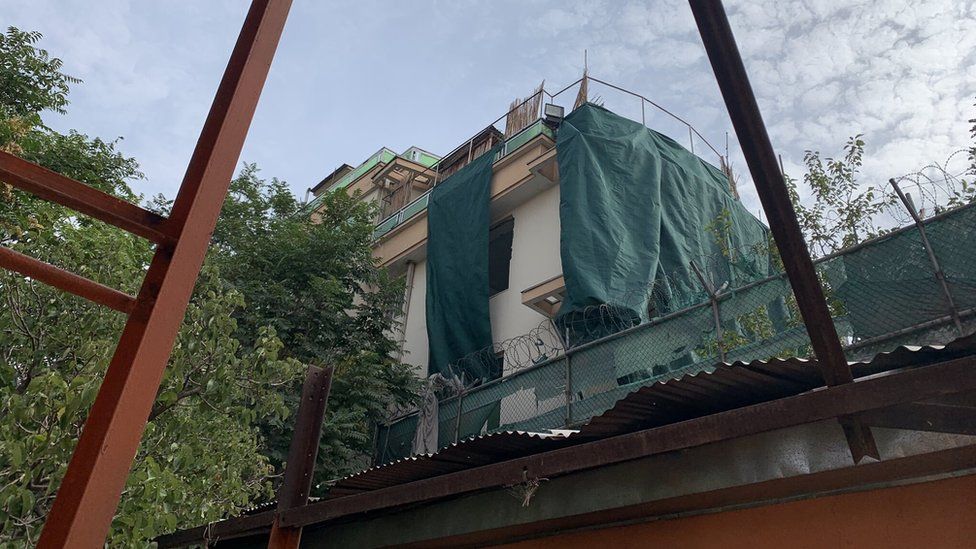
Just over an hour after sunrise on 31 July, long-time al-Qaeda boss Ayman al-Zawahiri walked out onto the balcony of a downtown Kabul compound – reportedly a favourite post-prayer activity of the veteran Egyptian jihadist.
It would be the last thing he would do.
At 06:18 local time (01:38 GMT), two missiles slammed into the balcony, killing the 71-year-old but leaving his wife and daughter unscathed inside. All the damage from the strike appears to be centred on the balcony.
How was it possible to strike so precisely? In the past the US has faced criticism for strikes and targeting errors that have killed civilians.
But in this case, here’s how the type of missile, and a close study of Zawahiri’s habits, made it happen – and why more strikes could follow.
Laser accuracy
The type of missile used was key – and these were said by US officials to be drone-fired Hellfires – a type of air-to-surface missile that has become a fixture of US counter-terrorism operations overseas in the decades since the 11 September 2001 attacks.
The missile can be fired from a variety of platforms, including helicopters, ground vehicles, ships and fixed wing aircraft – or, in Zawahiri’s case, from an unmanned drone.
The US is believed to have used Hellfires to kill Iranian general Qassem Soleimani in Baghdad in early 2020, and the British-born Islamic State jihadist known as “Jihadi John” in Syria in 2015.
Among the main reasons for the Hellfire’s repeated use is its precision.
When a missile is launched from a drone, a weapons operator – sometimes sitting in an air-conditioned control room as far away as the continental US – sees a live video stream of the target, which the drone’s camera sensors feed back via satellite.
Using a set of “targeting brackets” on the screen, the camera operator is then able to “lock up” the target and point a laser at it. Once the missile is fired, it follows the path of that laser until striking the target.
Read more: https://www.bbc.com/news/world-us-canada-62400923


